Two (of six) Reasons Transport Planning Misses the Mark
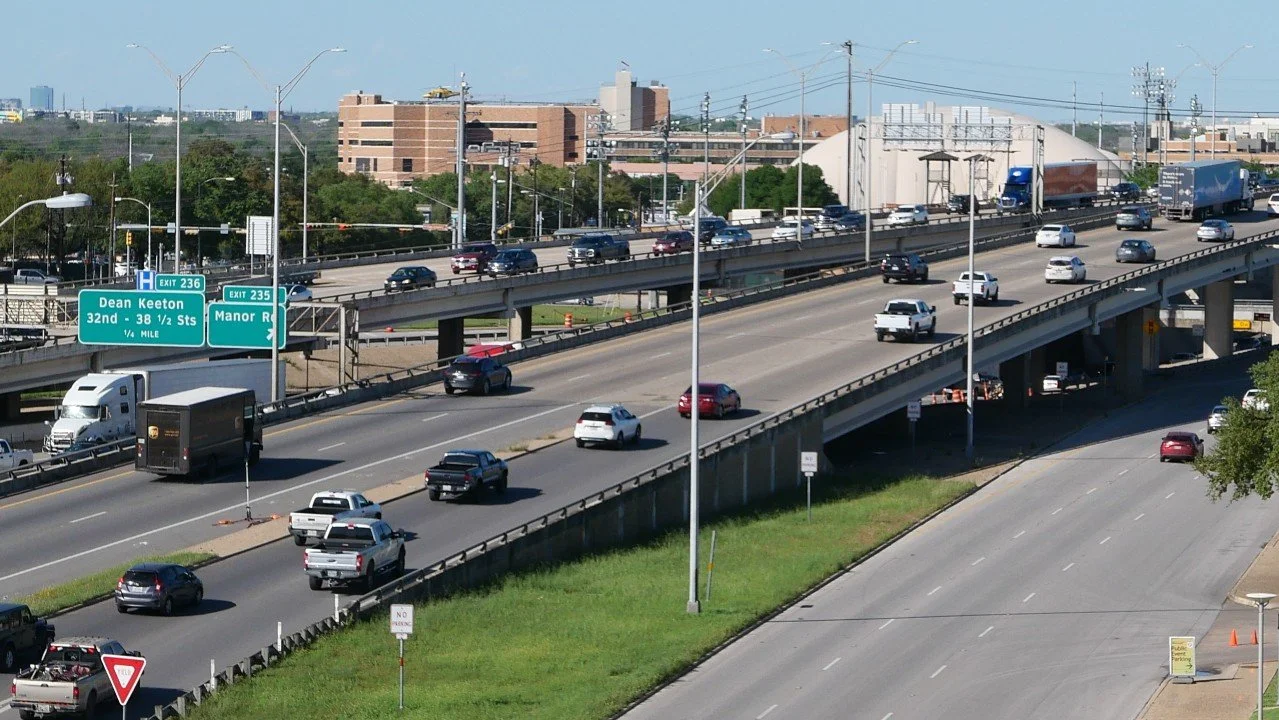
Photo of I-35 in Austin, Texas, March 2023 by Greg Griffin
The previous edition of the Transport Truths newsletter addressed what Pope Francis and AI have to do with Transportation Methods and Ethics. The world seems to have launched forward in the few weeks since then, as we mourn the pontiff's passing. In this fast-moving world, I try to see every day as an opportunity to improve on where we were yesterday. Surely, knowing where we made mistakes is key to planning a better future. For all the benefits of transport planning, the field also has plenty of common oversights. In this newsletter, I briefly summarize two problems and suggest ways to address them in transport planning. Chapter 1 of my book Transport Truths (launching May 20th!) introduces four more factors that cause many of the problems we find in transport planning.
Braess' Paradox. Readers of this newsletter are probably already familiar with induced demand (a type of Jevons paradox), where a new road entices more traffic. But what about where not only does adding transportation capacity not solve congestion, but as David Levinson, Wes Marshall, and Kay Axhausen say, "in some cases, the counter-intuitive, paradoxical result that adding capacity leads to an average rise of travel times" (2017). Braess' paradox shows the addition of a new travel link can slow traffic, even when the total volume stays the same.
The oppose can be true as well, further demonstrating Braess' paradox. Removing travel lanes has, in some places, reduced overall traffic. For instance, pedestrianization of Manhattan's Broadway corridor improved taxi speeds in West Midtown by 7%, according to NYC DOT (2010).
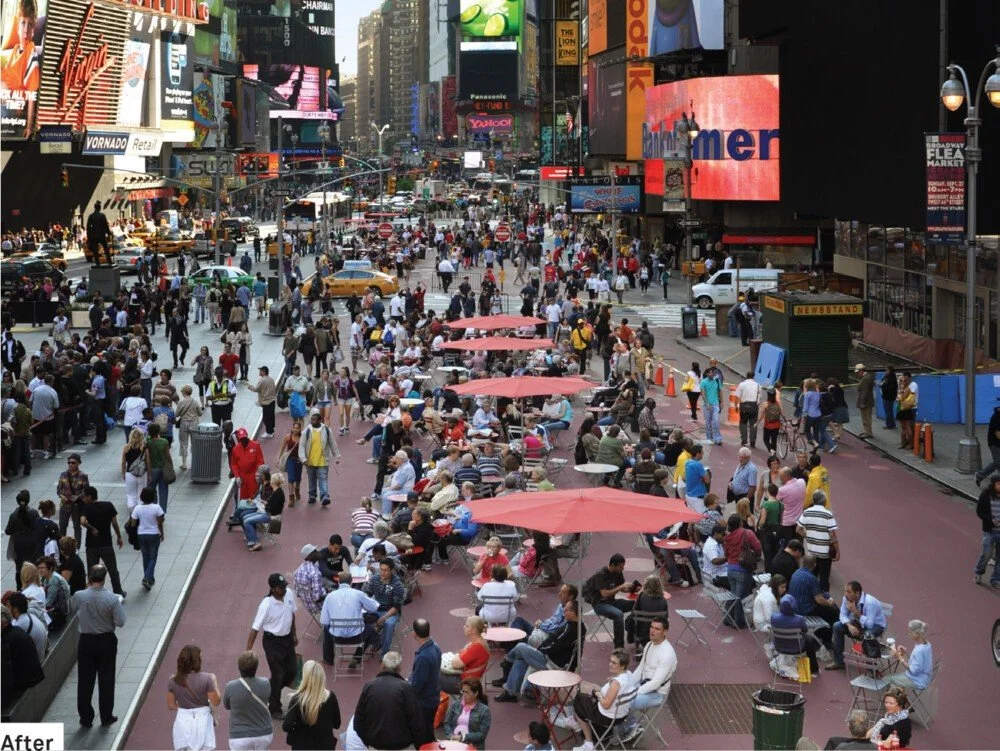
NYC Times Square Plaza Photo: NYC Department of Transportation (DOT)
With smartphones and GPS guiding drivers to optimize individual paths, adding a new, uncongested link might direct algorithms to choose this route, which could either increase travel times or cause even worse problems, depending on the interplay of the intersection flow and driver choices. Fortunately for us, mathematicians Stefan Bittihn and Andreas Schadschneider have already analyzed the effect of modern traffic information on Braess’ paradox, and found that "Braess’ paradox can still occur if agents make intelligent route choices based on traffic information" (2021). So, we can say for sure that adding roadway links does not always reduce travel times, even when people use GPS and similar tools.
This means that we can use this paradox to ask informed questions about roadway proposals: what is a similar project where traffic improved after construction? how does the traffic model incorporate the math of Braess' paradox? are there other projects that could improve conditions that might cost the same or less?
Understanding the role of additional traffic links is fundamental to addressing transportation problems as an improvement. Next, we need to explore what happens if we develop planning teams that fail to understand what human communities need in the first place.
Demographic bias. Transport planners, engineers, and researchers work to serve broad populations, but we also carry forward assumptions that can lose focus from who those populations are and what they need. One assumption is that peak congestion in the morning and evening along highways and arterials connecting downtowns and suburban areas deserve the most investment. Work from Tara Goddard, Susan Handy, and Xinyu Cao (2006) and my doctoral mentor Sandra Rosenbloom and Maryvonne Plessis Fraissard (2011) shows that these assumptions may prioritize the needs of populations who are more likely men. Lower-income communities who may need the most transportation support to access jobs more often commute off-peak, working multiple shifts and combining modes like carpooling and transit to get there. In 1998, the US Congress even established the Job Access and Reverse Commute (JARC) Program to ensure at least some funding supported the needs of communities often forgotten by demographic biases of transport professionals.
To address demographic bias, planners should evaluate past project outcomes for equity, and proactively involve representative-as-possible community members with the power to change outcomes, especially gender and intersections with other under-represented communities.
Together, Braess' paradox and demographic bias address some pretty big issues: traffic network behavior, and problem definition in planning. However, we should also consider the following, which are all part of Chapter 1 in Transport Truths:
Optimism bias, which is a problem for traffic forecasting;
Measurement bias that impacts whether the data really represents a thing;
Aggregation bias, where an analyst has to choose how to group data; and
Simpson's paradox, that effects causal implications from data analysis.
So, those of us who work in transportation and data directly should benefit by reviewing these challenges, and students and advocates can gain insights on how the sausage could be made better! None of this is to say that planning is doomed, models are always wrong (ok maybe they are), or that we should just stop trying.
We need to dig in. We can do better. Take a walk and think about it.