Why I Chose Open Science for Transport Truths
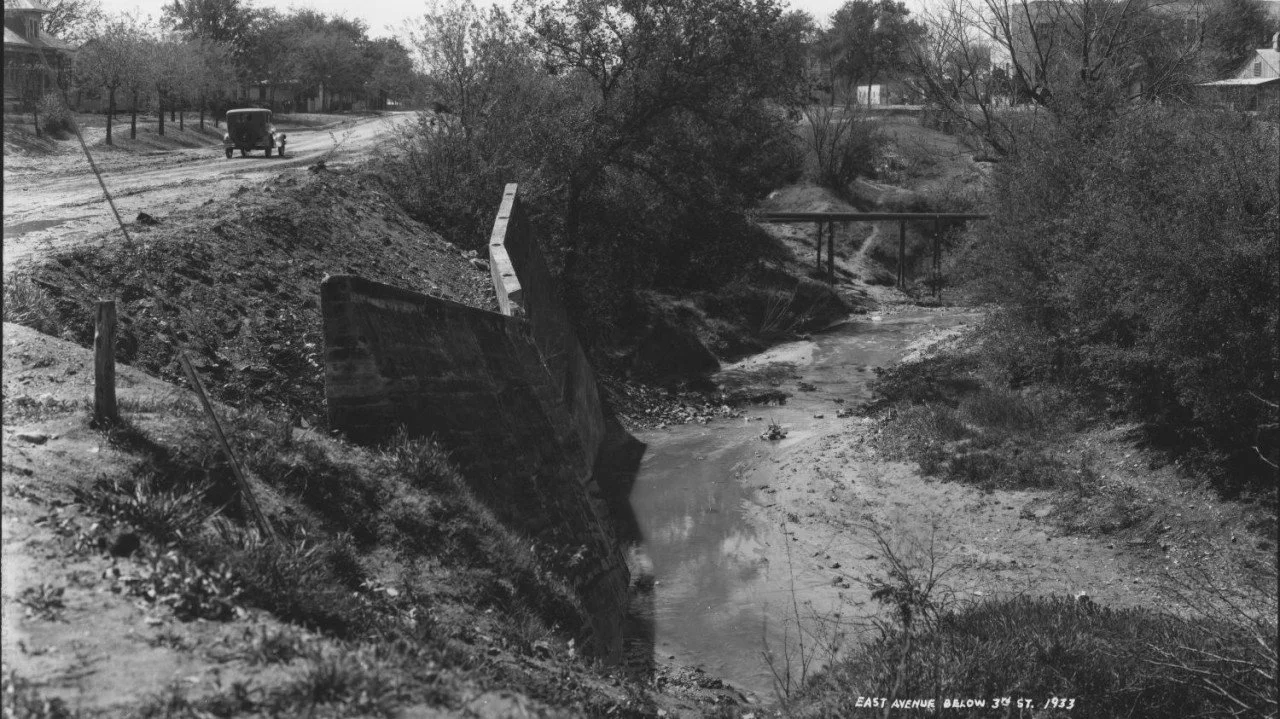
East Avenue in 1933, before it became I-35. Open archives allow understanding how the past shapes futures. (source: Austin History Center)
“Unlike laws and sausages, the public should see science during its manufacture…,” so claims philosopher John Wilkins. Yet, AI companies hoovering public knowledge to be re-sold to new publics is one reason full and open sharing of ongoing research could be risky.
When I started writing Transport Truths, I found there could be lots of questions that readers, peer reviewers, and other researchers might have about the project that do not fit neatly within a manuscript fit for publishing. A lot of what makes social science valid and reproducible is not what makes a gripping page turner, but is nonetheless important for a scientific process and product.
My first experience with sharing open access of a pre-publication study of social media in public transit with Jennifer Cowley, FAICP (now President of The University of Texas at Arlington), enabled sharing findings in this then-emergent field about a year earlier than the final ‘Microparticipation’ publication. However, sharing pre-publication findings is only one part of the larger open science approach.
If ‘distrust of science is rampant in the general population’ (Wolf 2023, p. 174) then could more transparency help grow knowledge toward reality? In this post, I explain why a selective open science approach worked for Transport Truths.
What is Open Science?
“Open Science is the movement to make scientific research, data, code, educational resources, and publications freely available to everyone without barriers,” according to the Encyclopedia of Libraries, Librarianship, and Information Science. In the United States, federal agencies that fund research were to create and update public access policies that specify how “to make publications and their supporting data resulting from federally funded research publicly accessible without an embargo on their free and public release,” since the end of 2025. PubMed is an example of a free, online archive of scholarly papers and books from the US National Institutes of Health, that every person online and curious about health has run across. However, open science[1] can also include open research software, methods, citizen science, even the peer review process, and infrastructure that supports scientific collaboration and educational resources
Open science in practice means that other researchers could use the same data and methods, and should be able to replicate the original results, supporting transparency about the process and findings. This approach has the potential to support the credibility of research, and speed advancements across research and implementation.
Managing Bias
A common critique of science includes perceptions of bias—often generalized notions that a researcher’s background or preconceived notions could influence the questions, analysis, or how they interpret results. To counter this challenge in my research, and to help keep me focused on a such a large project, I pre-registered my qualitative research questions, data collection, and analysis plan August 13, 2023 on the Open Science Framework (OSF) at https://doi.org/10.17605/OSF.IO/6JW8N. The document object identifier (DOI) number in the internet link is permanent, and OSF freezes pre-registration information for the pre-registration. Because no one can change the pre-registration, readers can be assured that I used my hypotheses to drive data collection and analysis—not the other way around.
Open pre-registration prevents bias by separating analysis that is planned in advance (called confirmatory analysis) from other analyses developed after reviewing the data (known as exploratory analysis). Exploratory analysis is not necessarily a problem when it is part of a natural discovery process, and it might not lead directly to bias. However, pre-registration prevents hypothesizing after results are known—so called ‘HARKing’—because specific research questions or hypotheses were entered at pre-registration. In my case, the pre-registration for Transport Truths was 647 days before publication on May 20, 2025.
Pre-registration or sharing draft documents can also establish a public timestamp of the work, protecting intellectual property against ‘scooping’ of ideas by other researchers. This was not a concern of mine for Transport Truths, since I was more interested in providing clarity on how transport disciplines produce knowledge over time and apply it in practice.
More generally, open science can increase the availability of research and information to broader audiences, bringing research to under resourced communities that may not have library access to expensive research databases and subscriptions. Inclusivity opens research to more diverse perspectives and can allow new voices to the scientific process, mitigating representation bias.
Open Access to the Avalanche, while Protecting Copyrights
The OSF page for Transport Truths also includes overview information, files, metadata, and links to side projects I used in the book such as a public participation GIS on Sustainable Tourism in The Gambia.
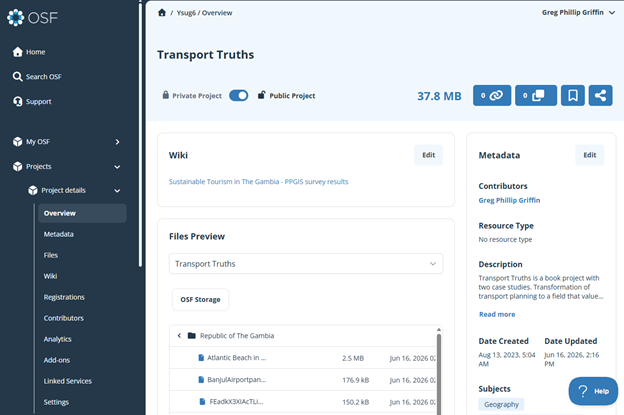
Screenshot of the OSF page for Transport Truths (https://osf.io/ysug6/overview)
Sharing datasets is valuable because it allows replication of the methods to determine if any analysis was incorrect, and it enables researchers to ask different questions of the same dataset. I included full-resolution, color images that I used in the book, and some images that help tell the story of the cases I used, even if they did not merit inclusion in the paper pages. However, I did not include transcripts of interviews, which I deemed to be of limited use beyond my focused scope. If a researcher is concerned about releasing data that would enable other researchers to ‘scoop’ their study by publishing first, then most open science platforms allow a self-imposed embargo, such as releasing the data publicly only after an initial publication.
I did not include any pre-publication versions of the manuscript, even though I might be able to avoid issues with the copyright holder of the final manuscript, Bristol University Press.
Platforms that create a DOI number for pre-registrations and pre-prints support the speed and accuracy of open science. First, researchers can use a DOI to cite products easily using reference management software like Zotero, which automates bibliographies precisely. Citing pre-publication products with DOI numbers speeds access to a specific method, database, or finding without depending on peer review, which could take a year or more. Freeing researchers from peer review of draft products also helps ensure that sometimes un-exciting, but nonetheless important findings that disprove previous findings, or provide negative results, can be cited anyway. Imagine the pre-eminent journal Science finding space to publish a replication study that merely supports previous research. Important, but not news-worthy stuff that may not merit a cover on Science, but should be available to support other research.
The Federal Open Science Debate
The Trump administration’s fiscal year 2027 budget request recommends that federal agencies essentially end using federal funding to support open access fees to publishers, according to the American Institute of Physics. The AIP also suggests the Biden administration’s Nelson memo—which required federally research products to be publicly available without a paywall or publishing embargo—could be rescinded.
Ending federal funding for open access publishing could make sense, given that free platforms to share research exist, such as arXiv, SSRN, university servers and databases. Additionally, this would partially de-fund potential predatory publishers and vanity presses such as those described in Beall’s List or Predatory Journals. Predatory publishers are essentially a pay-to-play publishing approach that shortchange peer review or omit it entirely, while purporting to support open access to scholarship.
However, posting a pre-print is not the same as a refereed and edited journal article. Pre-print servers do not include all the services of open science publishers like PLOS, which supports the broader scientific review enterprise, including data hosting, peer review, final editing, and perpetual hosting with no charges to libraries or the public to access research. Additionally, there are low-cost open access journals and platforms like Findings Press that charge a lean 150 USD to support rigorous peer review and costs of copyediting, typesetting and platform infrastructure. (Disclosure: I am a volunteer member of Transport Finding’s editorial board.)
Federal agencies like the US Department of Transportation have sought input on updates to their Public Access Plan, and the process forward will inherently include researchers, government officials, publishers, and politicians finding a way. The ~10B USD academic publishing market may be ripe for disruption, but the debate on the federal government’s role in open science and publishing is far from settled.
Is Open Science Right for Your Project?
Although open science approaches served my project for Transport Truths, not all studies can or should follow a similar approach. Research on open science from a workshop with transport experts suggest major advantages, including “increased innovation, increased efficiency, economic savings, more equality, and increased participation of citizens.” Despite these and the advantages I and others have shared, perceived barriers to openly sharing data or publications from a 2021 survey of transport experts include:
Data ownership and intellectual property,
Resource and organizational issues,
Competition with other institutions,
Data security issues,
Use of data for commercial purposes by private companies,
High cost and funding, and
Technical issues.
However, I would encourage researchers to view open science as an à la carte approach, rather than a prix fixe menu. Choose what aspects make sense for your project resources and needs. Pre-registering my qualitative methods, file hosting, and linking to supporting studies made sense for Transport Truths, but not hosting pre-print manuscripts. The Center of Open Science provides an introduction with a video that could help you explore whether the framework could support your research. Make your next study delicious.
--
P.S. One of the open science studies I reviewed for this essay was published in the well-respected open access journal Scientific Reports from Nature Publishing Group, and it is rife with typographical errors. This journal has an article publishing charge of 2850 USD, showing that price does not guarantee quality of editing, at least.
P.P.S. I did not use AI to brainstorm, draft, or review any of this content, despite common recommendations to do so. I think you, my readers, value any grammatical warts or human (mis)logic as a recognition of direct human engagement. This artisanal product was crafted in Portland, Oregon.